Setup
SOFI remains under Wheel management following assignment from the previously sold $17 Cash-Secured Put.
The position has been active since June and has already completed multiple Covered Call cycles.
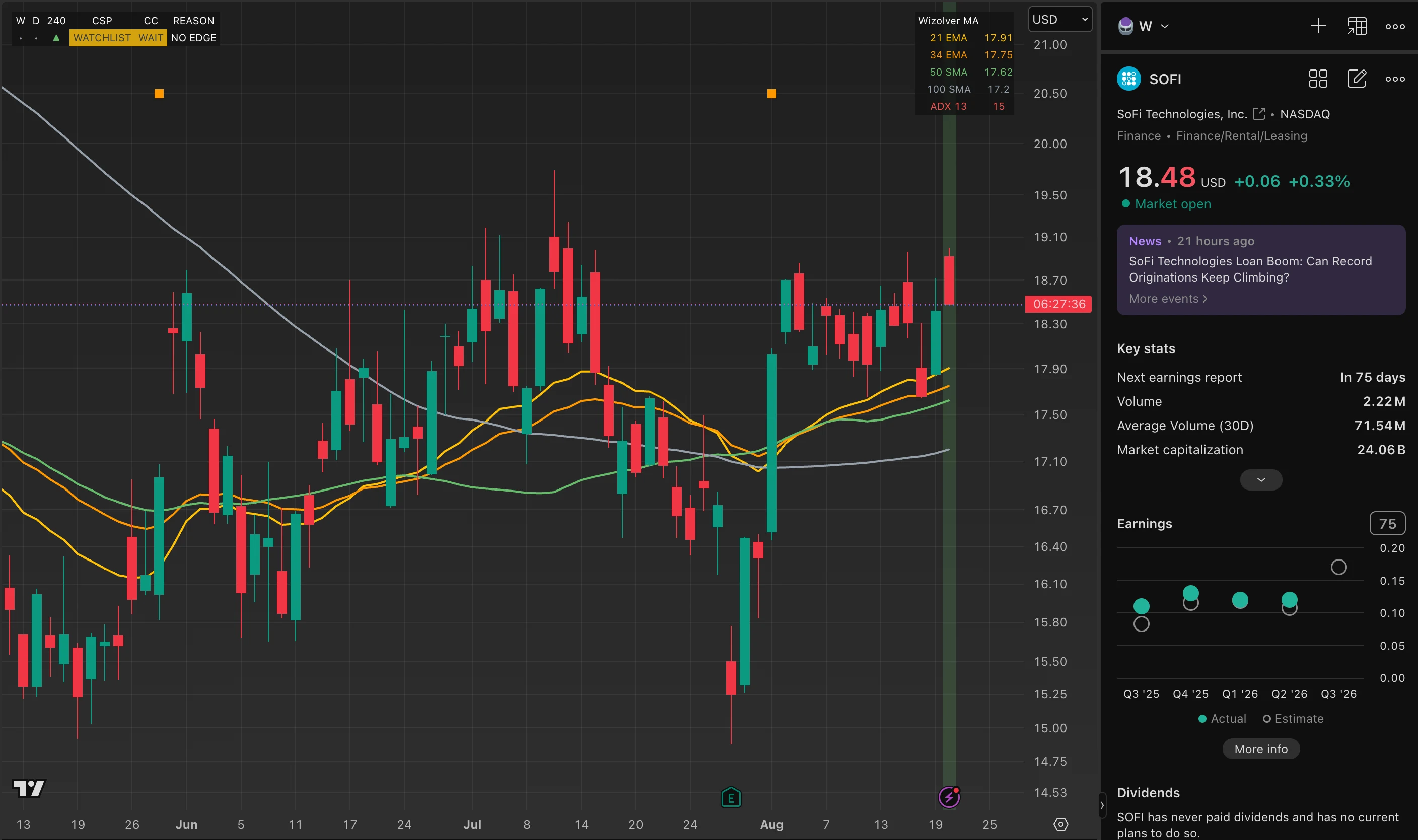
Following the most recent $19 Covered Call expiration, the shares were deliberately left uncovered while waiting for a better setup rather than forcing premium collection immediately.
SOFI has now recovered back into the mid-$18s and reclaimed the EMA21, EMA34, SMA50 and SMA100, making the $20 strike a better combination of premium, upside participation and assignment quality.
Structure
Covered Call sold at the $20 strike.
The strike sits $3 above the original $17 assignment price and well above the $15.34 effective cost basis accumulated through the Wheel cycle before this call.
With SOFI trading around the mid-$18s at entry, the $20 strike leaves roughly 7% additional upside before call-away while still generating $204 across the 1,200-share position.
Assignment Logic
The shares are already owned at a $17 assignment price.
If SOFI remains below $20 at expiration, the Covered Call expires worthless, the $204 premium is retained, and the effective cost basis falls from $15.34 to approximately $15.17.
If SOFI closes above $20 and the shares are called away, all 1,200 shares exit at $20, producing a $3 per-share stock gain relative to the original assignment price, or roughly $3,600 across the position.
Call-away is therefore not something that needs to be avoided, because the $20 strike represents an attractive and profitable exit.
Premium Context
Premium is fair.
The August 28 $20 call provides $0.17 per share with eight days until expiration.
The premium reflects:
- eight-day expiration
- improving price structure
- continued SOFI volatility
- roughly 7% distance to the strike
Using the $20 strike value of the covered shares as the capital reference, the premium represents about 0.85% over eight calendar days, or roughly 39% simple annualized APR.
This is not a high-IV premium trade; the premium itself is modest, and the quality comes from the exit structure rather than the credit alone.
Trade Structure
Management Plan
This Covered Call continues the existing SOFI Wheel cycle.
If SOFI remains below $20 through expiration, the call expires worthless, another $204 is added to the premium accumulated during the cycle, and the shares remain available for another Covered Call.
If SOFI rallies above $20 and the shares are called away, that exit is acceptable because the strike is $3 above the original assignment price and well above the effective cost basis of the complete position.
There is therefore no reason to roll simply to prevent assignment.
If the market takes the shares at $20, the Wheel has done exactly what it was designed to do: collect premium during ownership and eventually release the capital at an acceptable exit price.
Process Note
This trade could have been sold earlier, but waiting mattered because possible and attractive are not the same thing.
Instead of forcing a trade simply because SOFI was back above assignment price, the position was allowed to recover until strike, premium and exit quality made sense together.
Sometimes the highest-quality management decision produces no trade for several days; the position exists to make money, and the content exists to document the position rather than force activity.