Setup
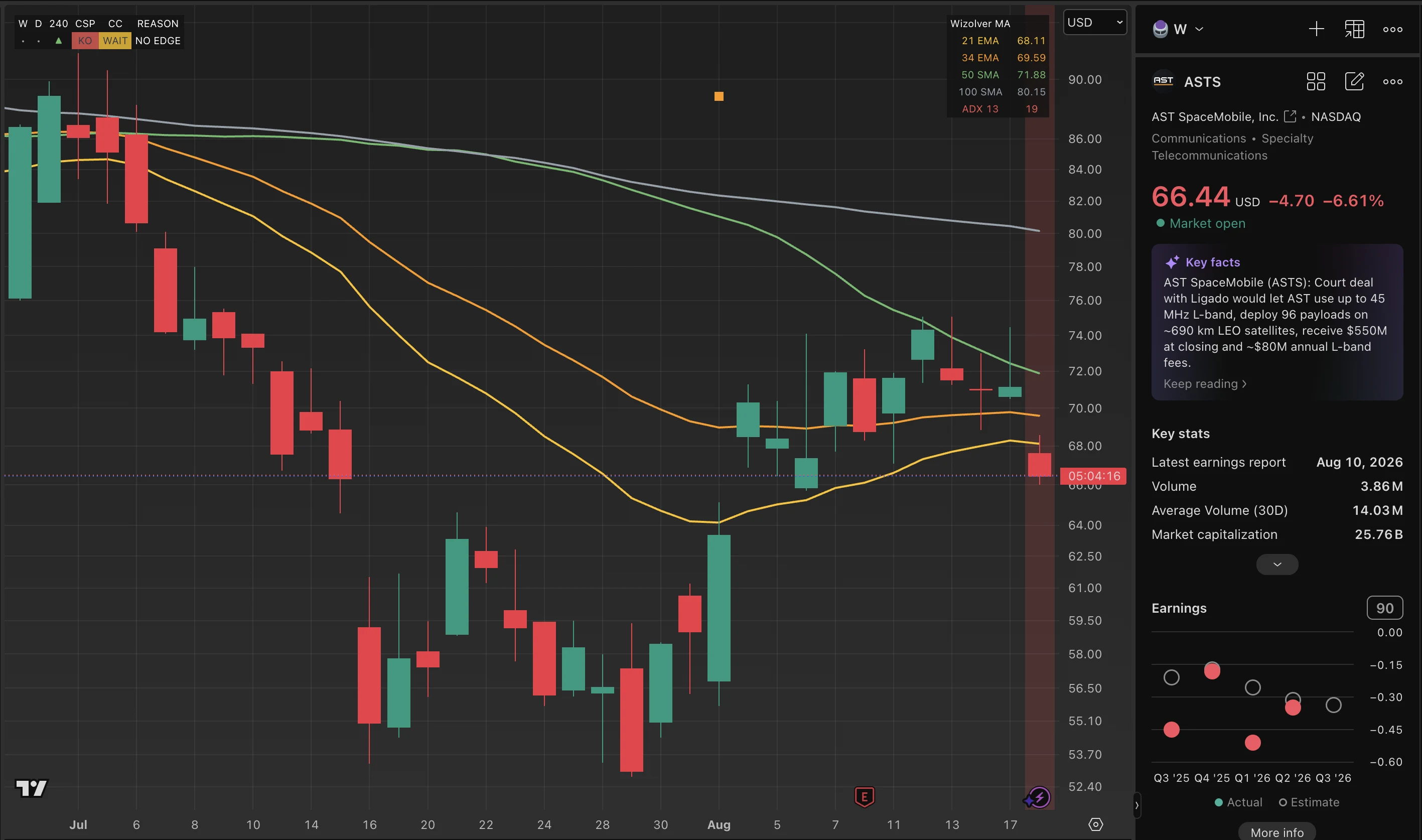
ASTS is entering a new Wheel cycle following a sharp pullback from its recent highs.
The stock was trading around $67 at entry after falling roughly 6% on the day, bringing price back below the shorter-term moving averages and toward the recent $63-64 support area.
Short-term momentum has become deeply oversold, with RSI(2) around 7.5, while price remains below the EMA21 near $68.16, EMA34 near $69.62 and SMA50 near $71.89.
ADX is about 19, marginally below the 20 threshold used by the standard Wheel filter, so this is a discretionary acceptance of a borderline reading rather than a perfect mechanical pass.
Structure
Cash-Secured Put sold at the $65 strike.
With ASTS trading around $67 at entry, the strike sits about 3% below the current share price.
The $1.45 premium reduces the effective assignment cost to $63.55, placing the effective basis directly inside the recent $63-64 support area and about 5% below the entry share price.
The expiration is only three days away, which keeps the exposure short while collecting meaningful premium during a period of elevated volatility.
Assignment Logic
This trade is structured around willingness to own ASTS.
If ASTS closes above $65 at expiration, the Cash-Secured Put expires worthless and the $580 premium is retained.
If ASTS closes below $65 and assignment occurs, 400 shares enter the Wheel at a $65 assignment price, with the premium reducing the effective basis to $63.55.
That effective basis sits directly around the recent $63-64 support zone, which makes assignment an acceptable transition into the Covered Call phase rather than a failed outcome.
The support zone is not treated as a guaranteed floor; the trade is acceptable because $63.55 is an ownership level I am willing to accept even if volatility remains high.
Premium Context
Premium is elevated.
The August 21 $65 put provides $1.45 per share with only three days remaining until expiration.
The premium reflects:
- approximately 80% implied volatility
- high realized volatility
- a sharp red day
- three-day expiration
- uncertainty around whether $63-64 support will hold
Across four contracts, the trade collects $580 against $26,000 of secured capital, which is about 2.23% over three calendar days and roughly 271% simple annualized APR.
That annualized number is not the thesis; the reason for accepting the risk is that the credit moves the effective ownership price from $65 to $63.55, directly into the technical area where ownership is acceptable.
Trade Structure
Management Plan
This Cash-Secured Put begins a new Wheel cycle.
With only three days until expiration, there is little reason to overmanage normal price movement.
If ASTS remains above $65 through expiration, the puts expire worthless and the full $580 premium is realized.
If assignment occurs, 400 shares enter the portfolio at $65 with an effective basis of $63.55 after the initial premium and the position transitions into the Covered Call phase.
The trade exists because $63.55 is an ownership price that is acceptable relative to the current support structure, not because assignment must be avoided.
Process Note
This setup highlights an important limitation of mechanical filters: ASTS is at about ADX 19, and the filter is correctly signaling that confirmed trend strength is missing.
But a threshold should not create false precision, because ADX 19 and ADX 20 do not represent two fundamentally different markets.
I am not taking the trade because the APR annualizes to roughly 271%; I am taking it because the premium creates an effective ownership price of $63.55 directly inside the technical zone where ownership is acceptable.
The filter provides discipline, while the complete setup determines whether a borderline reading actually changes the assignment thesis.