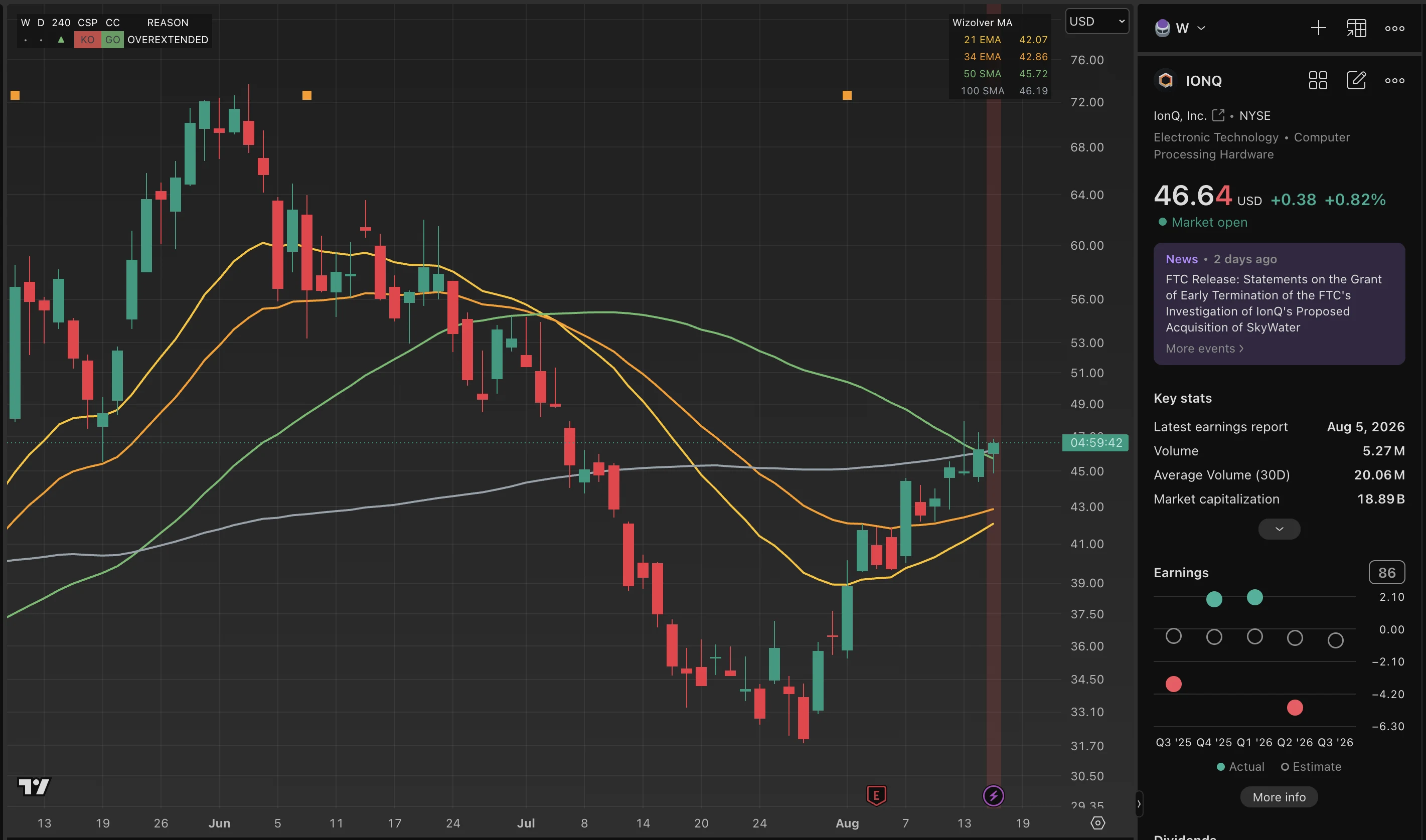
Setup
IONQ remains under Wheel management following assignment from the previously sold $57 Cash-Secured Put.
The position has now gone approximately 38 days without a Covered Call, and that inactivity was deliberate.
Available strikes were unattractive while IONQ traded deep below the original assignment price, so I waited while the stock recovered from the low-$30s back toward the $46-47 area.
That recovery now creates an opportunity to resume premium collection without selling below the effective cost basis of the complete Wheel cycle, which prior premium has already reduced to $47.37.
Structure
Covered Call sold at the $50 strike.
The strike sits below the original $57 assignment price but above the $47.37 effective cost basis accumulated through the Wheel cycle, while still leaving roughly 7% upside from the current share price.
The expiration is only four days away, which keeps the commitment short while monetizing the recent recovery after an extended period without Covered Call income.
Assignment Logic
The shares are already owned.
If IONQ remains below $50 at expiration, the Covered Call expires worthless, the $116 premium is retained, and the effective cost basis falls from $47.37 to approximately $46.79 before the next Covered Call is evaluated.
If IONQ closes above $50 and the shares are called away, all 200 shares exit at $50, which is below the original $57 assignment price but still above the accumulated effective cost basis.
That distinction is critical because call-away at $50 would still leave the complete Wheel cycle profitable while releasing approximately $10,000 of capital for redeployment.
Premium Context
Premium is attractive for the short duration.
The $50 call provides $0.58 per share with only four days until expiration while keeping the strike approximately 7% above the current share price.
The premium reflects:
- strong recent recovery from the low-$30s
- elevated volatility in IONQ
- short-duration expiration
- proximity to the SMA50 / SMA100 area
The premium is useful, but it is not the primary reason for the trade.
The more important consideration is that the accumulated Wheel premium has already reduced the effective cost basis enough to make $50 an acceptable profitable exit for the complete cycle.
Trade Structure
Management Plan
This Covered Call resumes active premium collection after approximately 38 days without a call on the IONQ position.
The objective is not to recover the original $57 assignment price at any cost.
The objective is to manage the entire Wheel cycle profitably, whether that means another premium capture below $50 or call-away at a still-profitable complete-cycle exit.
If IONQ remains below $50 through expiration, the call expires worthless and the effective cost basis falls to approximately $46.79.
If IONQ rallies through $50 and the shares are called away, roughly $10,000 of capital is released for redeployment into a new Wheel setup.
Process Note
There is an important difference between selling a Covered Call below assignment price and selling a Covered Call below effective cost basis.
IONQ was assigned at $57, but the Wheel did not stop operating at assignment because premium collected throughout the cycle has already reduced the real economic basis to $47.37.
That is why the $50 strike can still represent a profitable complete-cycle exit even though it sits below the original assignment price.