Setup
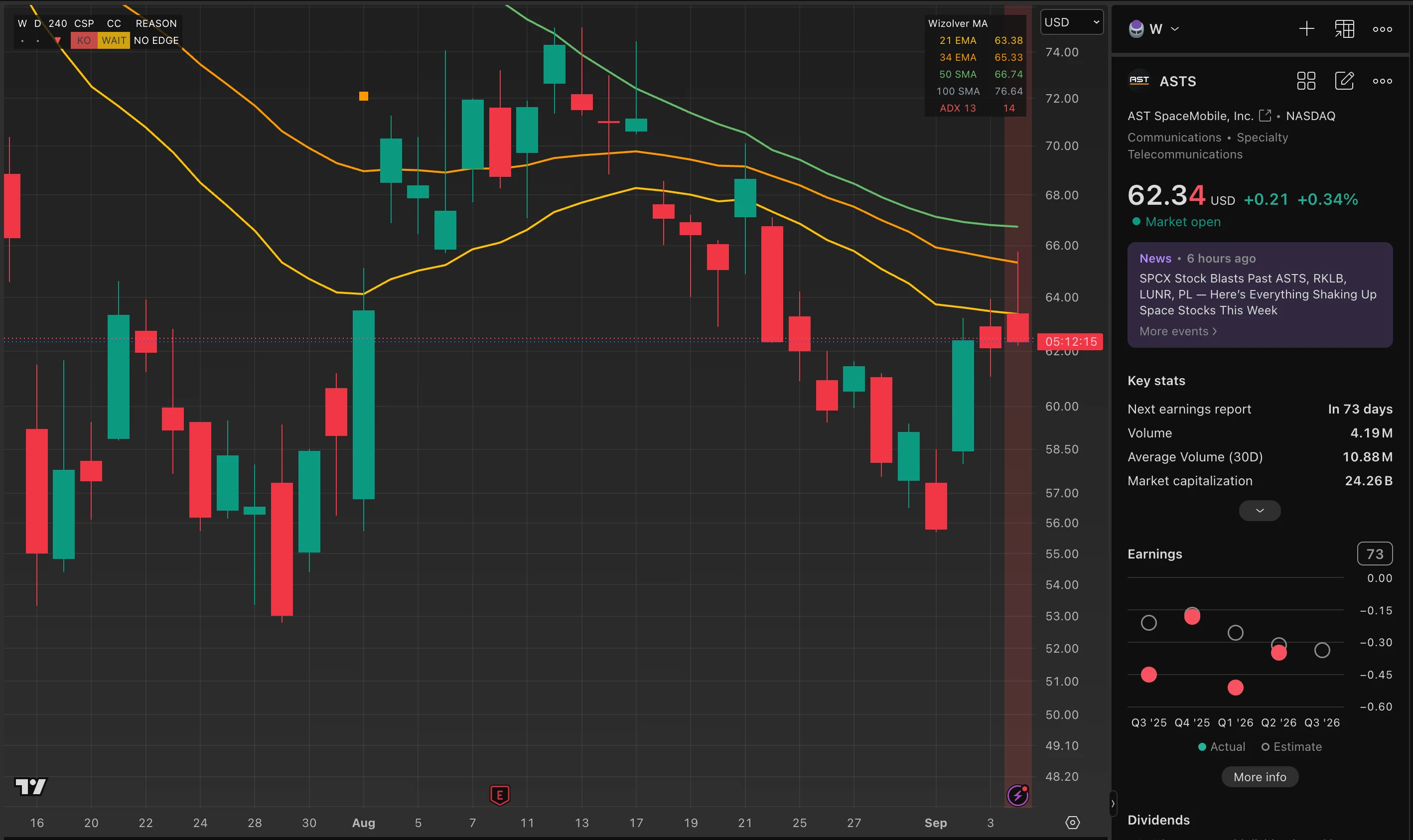
ASTS enters a new Cash-Secured Put cycle after another pullback toward the lower portion of its recent trading range. Shares traded around $62.26 at entry.
The stock recently bounced from approximately $55-$56 into the low-$70s, then pulled back again. Price is now below the major short-term moving averages: EMA21 near $63.37, EMA34 near $65.33, SMA50 near $66.73, and SMA100 near $76.63.
This is not a trend-confirmed CSP entry. The chart remains weak, with ADX near 14, but price has already moved back toward an area where I am willing to begin owning ASTS rather than sitting below an extended rally.
ADX remains relevant because current trend strength is weak, but it is not a mechanical veto. Strike, effective assignment basis, recent support, expiration, and willingness to own the underlying determine the final decision.
Structure
Cash-Secured Put sold at the $60 strike, expiring September 11 with seven days to expiration.
Premium is $1.30 per share, or $650 across five contracts. Cash secured is $30,000.
The premium reduces the effective assignment basis from $60.00 to $58.70. With ASTS around $62.26 at entry, the strike sits approximately 3.6% below spot and the effective ownership level approximately 5.7% below spot.
The relevant areas are approximately $62.26 at entry, the $60 strike, the $58.70 effective basis, and the recent $56-$60 reaction region. The true recent swing low near $55-$56 means $58.70 is not a guaranteed floor, but it remains an ownership price I am currently willing to accept.
Assignment Logic
This trade is structured around willingness to own ASTS.
If ASTS remains above $60 through September 11, the puts expire worthless, the $650 premium is retained, and the $30,000 of secured capital is released.
If ASTS closes below $60, 500 shares enter the portfolio at the $60 strike with an effective ownership basis of $58.70 per share after premium.
That basis sits inside the broader recent $56-$60 trading region, so assignment is acceptable and would move the position into the Covered Call phase of the Wheel.
The primary risk is a break through the recent $55-$60 structure and a material move lower after assignment. The premium improves ownership price from $60 to $58.70; it does not eliminate that risk.
Premium Context
Premium is fair.
The September 11 $60 put provides $1.30 per share with seven days until expiration, or $650 across five contracts on $30,000 cash secured.
The premium reflects:
- high realized volatility
- weak current trend structure
- proximity of the $60 strike
- seven-day expiration and uncertainty around the $56-$60 support region
- the possibility of another sharp downside move
The $650 credit on $30,000 cash secured is a 2.17% return over seven calendar days, or approximately 113% simple annualized APR. ASTS implied volatility is in the low-70% range while recent historical volatility is above 80%, so implied volatility is not unusually elevated relative to realized movement.
The annualized APR is not the reason for the trade. The credit matters because it lowers effective ownership price to $58.70, a level where I am currently willing to accept assignment.
Trade Structure
Management Plan
If ASTS remains above $60 through September 11, the puts expire worthless, the full $650 premium is retained, and the $30,000 of secured capital is released.
If assignment occurs, 500 shares enter at $60 with an effective basis of $58.70 after premium and transition into Covered Call management.
I am not entering this trade with the objective of avoiding assignment at all costs. The trade exists because I am currently willing to own ASTS at the resulting $58.70 effective basis.
If the stock breaks materially below recent support, any assigned shares will be managed based on the conditions that exist then.
The $56-$60 area is a reference zone, not an assumption that price cannot move lower.
Process Note
This trade reflects an adjustment in how ADX is used in the Wheel process. ADX near 14 confirms that ASTS does not currently have strong trend confirmation, but it does not automatically make $58.70 a bad ownership price.
Treating 19 as acceptable and 18 as unacceptable, or 20 as safe and 14 as impossible, creates more precision than the indicator provides. ADX remains part of context, not an automatic veto.
ASTS remains below EMA21, EMA34, SMA50, and SMA100, so weak structure is fully acknowledged. At the same time, price has pulled back substantially from its highs and recently reacted around $55-$56 instead of being sold after an extended upside move.
The $60 strike is approximately 3.6% below spot and the $1.30 credit reduces effective assignment price to $58.70. The premium compensates risk; it is not free edge. If ASTS stays above $60, I collect $650. If assigned, I own 500 shares at an effective $58.70. Both outcomes were acceptable before entry.