Setup
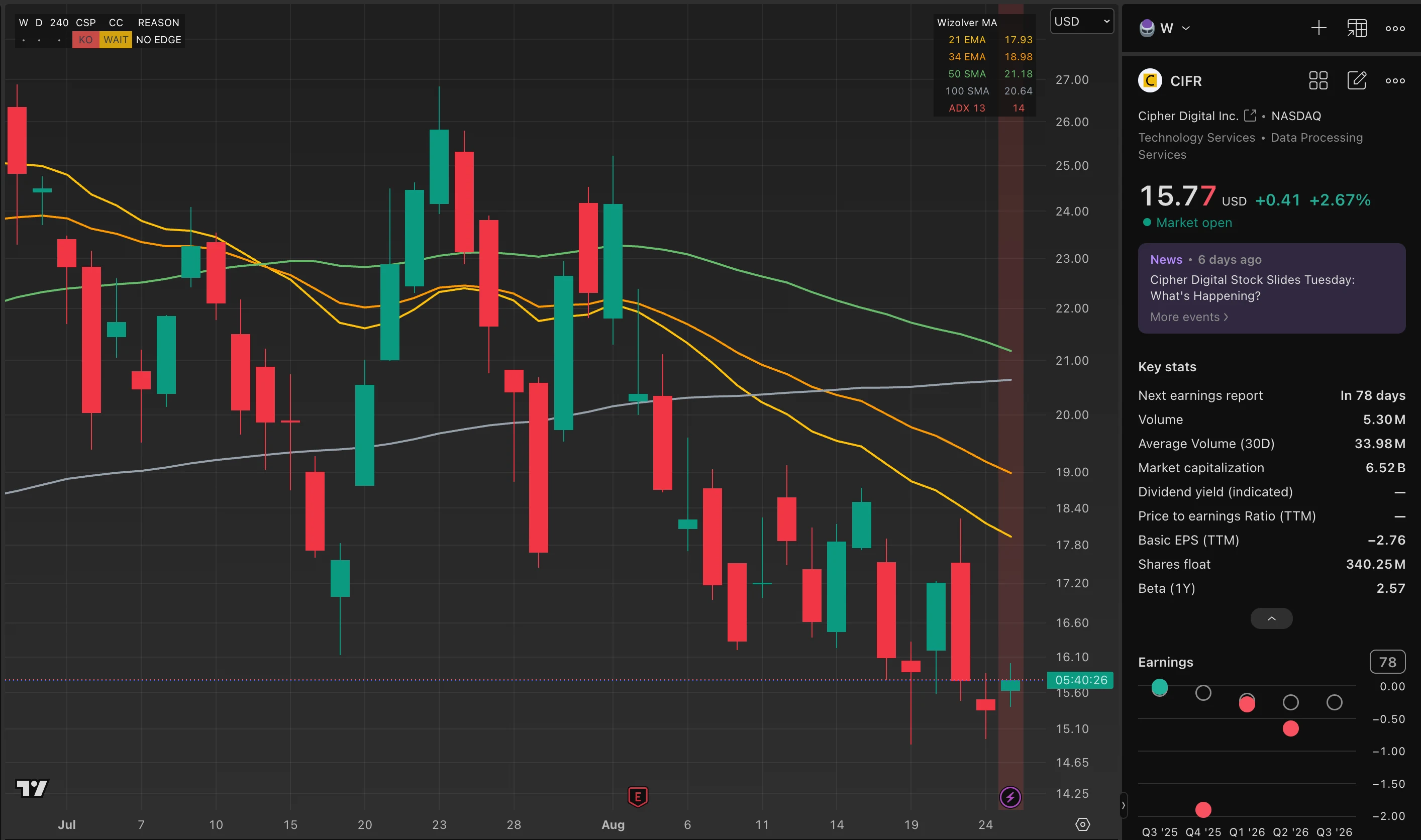
CIFR enters a new Cash-Secured Put cycle with shares trading around $15.75 at entry after a substantial decline from recent highs.
Price remained below the EMA21, EMA34, SMA50, and SMA100, while ADX was approximately 14.
This was not a trend-confirmed CSP entry, and that weak structure directly affected strike selection.
The trade is therefore a discretionary exception, and the larger-than-normal size is part of the recorded trade context.
Structure
Cash-Secured Put sold at the $14 strike.
Rather than selling the closer $14.50 put for additional premium, the strike was moved down to $14 to improve ownership economics if assignment occurs.
With CIFR around $15.75 at entry, the strike sits approximately 11.1% below the underlying price.
The $0.46 premium lowers effective assignment basis to $13.54, putting the effective ownership price approximately 14% below the stock price at entry.
The alternative $14.50 put was available around $0.58, which would have added about $120 of immediate premium across 10 contracts, but at the cost of a worse ownership basis.
Assignment Logic
Assignment is acceptable at the defined basis.
If CIFR remains above $14 through September 4, the Cash-Secured Put expires worthless, the $460 premium is retained, and the $14,000 of secured capital is released.
If CIFR closes below $14 and assignment occurs, 1,000 shares enter the Wheel at an assignment price of $14, with the collected premium reducing the effective basis to $13.54.
The lower strike does not remove downside risk, because CIFR remains below its major moving averages and can continue materially below $13.54 after assignment.
The purpose of moving from $14.50 to $14 is simply to improve the ownership economics if assignment occurs.
Premium Context
Premium is fair.
The September 4 $14 put provides $0.46 per share with ten days remaining until expiration.
The premium reflects:
- high volatility in CIFR
- weak technical structure
- short-duration option time value
- real assignment risk below the major moving averages
Across ten contracts, the trade collects $460 against $14,000 of secured capital, which is about 3.29% over ten calendar days and roughly 120% simple annualized APR.
Implied volatility was approximately 102% versus recent historical volatility near 134%, so the premium should not be interpreted as unusually favorable edge.
The headline APR is high because CIFR is a highly volatile underlying, not because the setup is especially safe.
Trade Structure
Management Plan
This Cash-Secured Put begins a new Wheel cycle.
If CIFR remains above $14 through expiration, the puts expire worthless and the full $460 premium is realized.
If assignment occurs, 1,000 shares enter the portfolio at $14 with an effective basis of $13.54 after the initial premium.
The position would then transition into Covered Call management if the ownership thesis remains intact.
Because ADX remains below the normal threshold, this position is explicitly recorded as a discretionary exception rather than a standard filter-approved entry.
Process Note
Choosing $14 instead of $14.50 gives up approximately $120 of immediate premium.
In exchange, the trade improves potential ownership price by $0.38 per share, or approximately $380 across 1,000 shares.
With CIFR still technically weak, the better ownership price matters more than the additional premium.
The assignment price matters more than the headline APR.