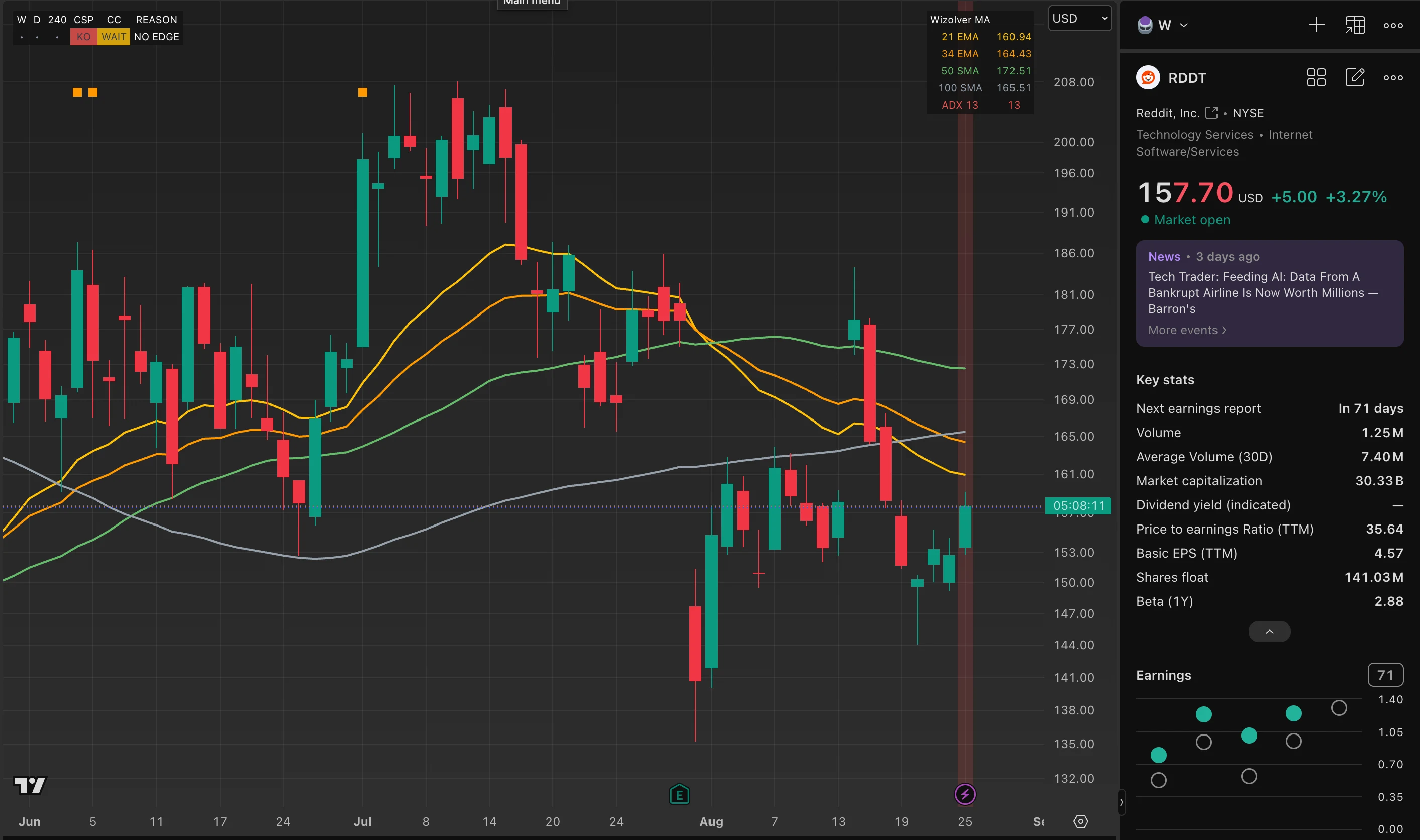
Setup
RDDT remains under Wheel management following assignment of 100 shares at the $190 strike.
Premium already collected during the cycle has reduced the effective cost basis to $183.60.
The position has now spent approximately 32 days without a Covered Call, because the current effective basis remains too far above the market for attractive call management.
This is not a normal standalone CSP entry. The objective is to improve the ownership structure of an existing Wheel position and reduce the distance RDDT needs to recover before useful Covered Calls become available again.
Structure
Cash-Secured Put sold at the $145 strike.
Expiration is September 4, giving the position 10 days to expiration.
The $1.75 premium reduces the effective assignment basis on the new shares to $143.25.
If another 100 shares are assigned at that effective price, the blended basis of the complete position becomes approximately $163.43.
The $150 strike was also available and offered considerably more premium, but the lower $145 strike sacrifices some immediate credit in exchange for a better ownership price and a better potential blended basis.
Assignment Logic
Assignment is an acceptable outcome.
If RDDT remains above $145 through September 4, the put expires worthless, the $175 premium is retained, and the $14,500 of secured capital is released.
The existing 100 shares remain under Wheel management.
If RDDT closes below $145 and assignment occurs, another 100 shares enter at the $145 strike, with the collected premium reducing the effective basis of the new shares to $143.25.
The complete position would then consist of 200 shares with an approximate blended effective basis of $163.43, materially changing the recovery profile for future Covered Call management.
Premium Context
Premium is fair.
The September 4 $145 put provides $1.75 per share with 10 days until expiration.
The premium reflects:
- standard short-dated option value
- continued uncertainty in RDDT
- the risk of accepting another 100 shares at $145
- a setup where cost-basis improvement matters more than premium maximization
Across one contract, the trade collects $175 against $14,500 of secured capital, which is about 1.21% over ten calendar days and roughly 44.1% simple annualized APR.
RDDT's IV rank is around 11 and IV percentile around 8%, so the option is not unusually expensive relative to RDDT's own volatility history.
This is not a trade where premium is the primary edge. Cost-basis improvement is the objective.
Trade Structure
Management Plan
If RDDT remains above $145 through expiration, the put expires worthless, the $175 premium is retained, and the secured capital is released.
I continue managing the existing 100 shares and wait for either another CSP opportunity or a recovery that makes Covered Calls attractive again.
If assignment occurs, another 100 shares enter at an effective basis of $143.25 and the combined position moves to approximately $163.43 blended effective basis.
Future Covered Calls would then be evaluated against that lower blended basis. One additional contract is intentional, and there is no plan to continue adding automatically if RDDT keeps falling.
Process Note
I still like Reddit, but I do not like the speed of the current position.
The existing 100 shares have spent approximately 32 days without a Covered Call because the $183.60 effective basis remains too far above the market.
Instead of waiting indefinitely or buying another 100 shares immediately, I sold the $145 put to define the price where I am willing to add while collecting $175 in the meantime.
I also deliberately chose $145 instead of the richer $150 strike, because the lower assignment price matters more here than maximizing immediate premium.