Setup
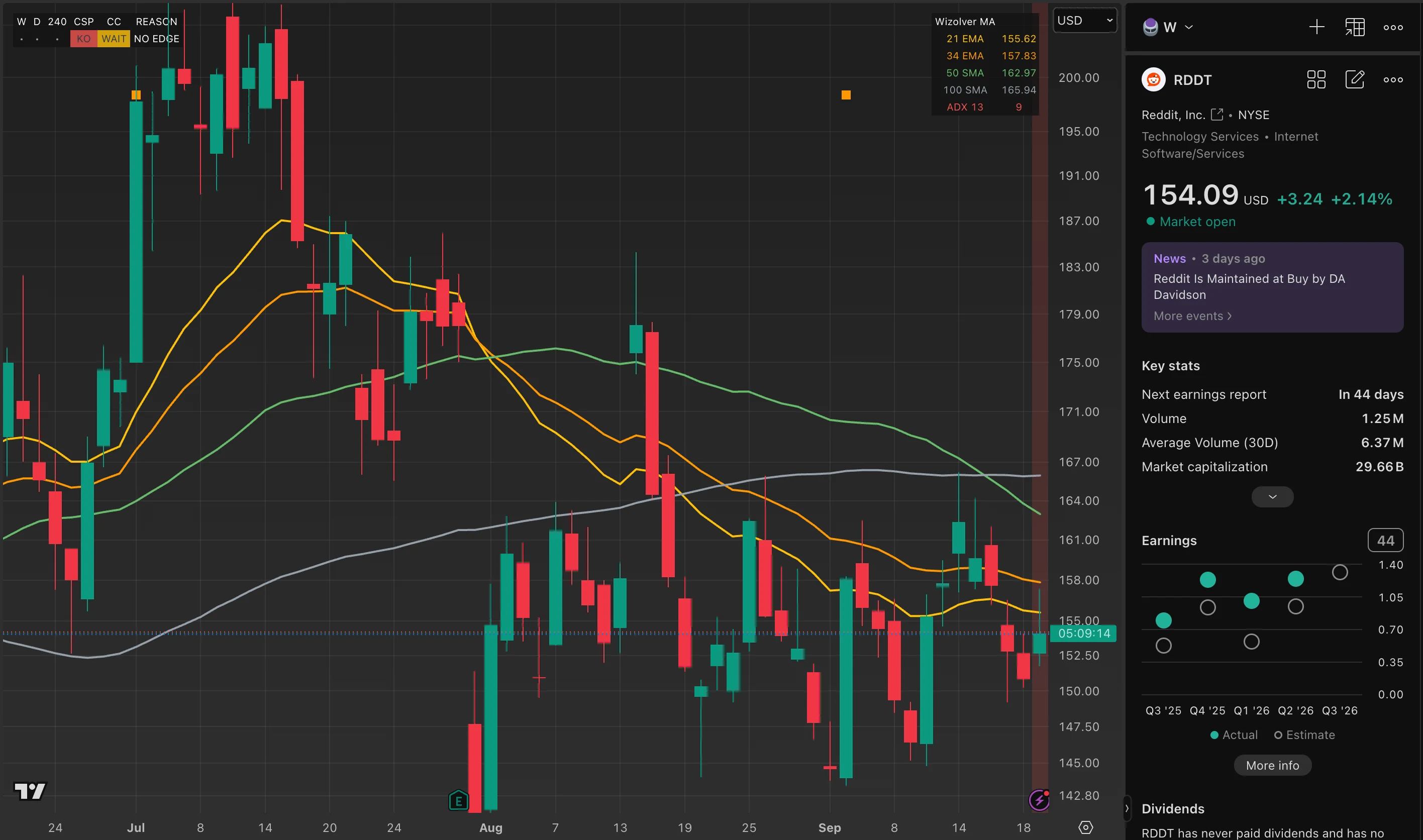
RDDT remains under Wheel management following assignment of 100 shares at $190, with an effective cost basis of $183.60.
Covered Call management remains difficult with RDDT near $154, materially below that basis.
The September 18 $145 recovery CSP expired worthless, collecting $291 without adding another 100 shares, but the underlying recovery problem remained.
One October 2 $150 CSP was sold at $4.20 to define a second entry closer to market while limiting added exposure to one contract.
Structure
One Cash-Secured Put was sold at the $150 strike, expiring October 2, 2026.
The position collected $4.20 per share, or $420 total, against $15,000 in collateral.
The premium reduces the effective assignment basis on new shares to $145.80, near the broader $144-$147 reaction area.
If assigned, the new $145.80 entry would reduce the blended basis of 200 shares from $183.60 to approximately $164.70.
Assignment Logic
Assignment is an acceptable outcome.
If RDDT remains above $150 through October 2, the put expires worthless, the $420 premium is retained, and the $15,000 of secured capital is released.
If assigned, another 100 shares enter at the $150 strike with an effective basis of $145.80.
The complete position would then consist of 200 shares with an approximate blended effective basis of $164.70.
Moving from the prior $145 recovery strike to $150 accepts a higher assignment probability, intentionally limited to one contract because the premium materially improves either outcome.
Premium Context
The October 2 $150 put provides $4.20 per share over 11 days, producing $420 on $15,000 in secured capital.
That equals a 2.80% return on secured capital, or approximately 92.9% simple annualized APR.
Premium conditions were fair rather than an option-pricing edge:
- implied volatility was around 57%
- recent historical volatility was approximately 57%
- IV Rank was low, around 10-11%
- the strike was relatively close to the current market price
- the $420 absolute premium was meaningful relative to the existing 100-share position
The shorter-dated $147 recovery put offered roughly $140 against almost $14,700 of possible additional exposure, which was not enough.
This trade pays $420 while holding added exposure to one contract. Premium is meaningful; cost-basis improvement remains the objective.
Trade Structure
Management Plan
If RDDT remains above $150 through October 2, the put expires worthless, the $420 premium is retained, and secured capital is released.
The existing 100 shares remain under Wheel management while waiting for another recovery opportunity or a price recovery that makes Covered Calls practical again.
If assigned, another 100 shares enter at an effective basis of $145.80 and the blended basis becomes approximately $164.70.
Future Covered Calls would be evaluated against the lower blended basis, not sold aggressively simply because the basis improved.
The trade creates a more manageable ownership structure while preserving an acceptable exit. No automatic additions follow if RDDT keeps falling.
Process Note
The prior September 18 $145 recovery put collected $291 without adding another 100 shares, but RDDT still remained well below the $183.60 effective basis.
A shorter-dated recovery put near $147 offered only around $140 against nearly $14,700 of potential additional exposure, so it was passed.
This one-contract $150 CSP pays $420. If worthless, it provides meaningful income; if assigned, the $145.80 effective entry lowers blended basis to approximately $164.70.
The closer strike accepts a greater assignment probability, but exposure is defined and the ownership price matters more than headline APR. No prediction. Just process.